
Moody's Ratings has downgraded India's growth forecast for financial year 2026-27 (FY27) to 6 per cent from 6.8 per cent, attributing the revision to weaker consumption and industrial activity, elevated energy prices, and rising input costs stemming from the West Asia conflict.

TVS Motor Company is strategically positioned for sustained outperformance in the domestic two-wheeler industry, propelled by increasing market share in scooters, premium motorcycles, electric vehicles (EVs), and robust export growth, according to analysts.

Indian companies recorded their highest profit margins in 21 quarters during Q4FY26, reaching 11.3 per cent, primarily due to significant savings from lower employee costs and reduced interest payments, which offset rising raw material prices.

Tata Motors' MD and CEO, Girish Wagh, has identified rising diesel prices as the most significant threat to India's commercial vehicle (CV) industry recovery, despite the sector recently surpassing its pre-FY19 wholesale peak. Diesel costs account for 25-50% of a truck operator's total cost of ownership, making any increase a critical concern for fleet economics.

Nayara Energy, a private fuel retailer in India, has increased petrol and diesel prices following a surge in global oil prices due to Middle East tensions. This move contrasts with state-owned retailers who continue to freeze prices.

Analysts predict that the ongoing conflict in West Asia, crude oil price fluctuations, and the US Federal Reserve's interest rate decision will significantly influence the Indian equity market this week.

Indian pharmaceutical companies are strategically increasing investments in the US market, focusing on specialty drugs, complex generics, respiratory products, and local manufacturing, despite a nearly 10 per cent fall in exports to the US in FY26 due to pricing pressure and competition in traditional generics.

Gold prices surged in futures trading due to escalating US-Iran tensions, driving demand for the safe-haven asset.

Indian equity benchmark indices Sensex and Nifty rallied in early trade, driven by reports of a second round of talks between the US and Iran, which are fostering hopes for a resolution to the West Asia conflict, coupled with Brent crude oil prices trading below the USD 100 per barrel mark.

The Indian rupee depreciated 16 paise to settle at a fresh lifetime low of 96.86 against the US dollar, marking its ninth consecutive session of decline, driven by elevated global crude prices and a strong dollar.

The Indian rupee appreciated by 23 paise to settle at 92.91 against the US dollar, driven by a weakening American currency, retreating crude oil prices, and renewed foreign institutional investor (FII) inflows amid increasing hopes of easing geopolitical tensions.
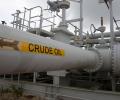
Crude oil prices experienced a significant drop following the announcement of a US-Iran ceasefire and the reopening of the Strait of Hormuz, leading to heavy selling by traders.

India's economy is projected to maintain growth above 7 per cent in 2026-27 (FY27), supported by strong domestic consumption and investment, even as global growth faces risks from geopolitical tensions, according to industry body Assocham.

Barack Obama's re-election as the President of the United States has proved favourable for commodities markets amid hope that the recently announced third round of quantitative easing (QE3) for brining liquidity into the financial system would continue in future as well.

Markets face risk of a prolonged bear phase as oil shocks and geopolitical tensions test inflation, growth and investor confidence globally, points out Debashis Basu.

Ola Electric is experiencing a significant rebound in the June quarter, with vehicle registrations in Q1 FY27 already exceeding the total registrations for Q4 FY26, indicating a strong recovery in demand.

The Indian rupee plummeted to an all-time low of 95.80 against the US dollar, settling at 95.66, driven by elevated crude oil prices and escalating geopolitical tensions in West Asia, despite potential RBI intervention and import curbs on gold.

'Customers do not recover the original making charges paid on old jewellery. Sentimental value is lost when heirlooms are exchanged.'

'Markets never fully lose hope. But an important shift could come if the Strait remains closed -- moving from high prices to no prices.'
Precious metal prices, particularly gold and silver, experienced a significant surge in the national capital as investors sought safe-haven assets amid escalating hostilities in the Middle East.
Precious metal prices surged in futures trading, with silver hitting Rs 2.93 lakh per kg and gold nearing Rs 1.68 lakh per 10 grams, driven by safe-haven demand following US-Israel strikes in Iran and retaliatory attacks.

The rupee recovered to 95.18 against the US dollar after hitting an all-time intra-day low of 95.44. The recovery was supported by possible RBI intervention amid renewed Gulf tensions and rising crude oil prices.

India's state-run oil marketing companies (OMCs) are projected to incur under-recoveries of approximately Rs 80,000 crore on liquefied petroleum gas (LPG) sales in FY27 if current loss levels persist, according to rating agency Icra.

'If the war continue for a longer period of time, it is just a matter of time before the government will pass on some of the price increases.'

India has emerged as the most impacted market within emerging economies, experiencing $3.7 billion in outflows over the past three weeks, matching the total outflows from the entire emerging market basket, as global equity funds turn negative for the first time since January 2026 due to escalating geopolitical tensions.

India emerged reasonably well from 2025. But now, the oil shock and war-related supply disruptions have again driven funds out of India and significantly weakened the rupee, points out Ajay Chhibber.
Commodity prices did rise as interest rates fell.

Gold prices experienced a significant drop in futures trading due to global selloff, inflation concerns, and a strong US dollar. Analysts predict a continued downward trend amid geopolitical tensions and potential rate hikes.

Gold and silver prices experienced a significant drop in the national capital due to a global selloff driven by inflation concerns, central bank policies, and geopolitical tensions.
The Indian rupee depreciated 20 paise to close at a fresh all-time low of 94.88 against the US dollar, driven by surging Brent crude oil prices, hovering around USD 115 per barrel, and persistent foreign capital outflows.

Households should moderate large discretionary expenses for the time being.
'They should prioritise essential spending. They should maintain an emergency fund covering 6 to 12 months of expenses.'

Crude oil prices have surged to record highs due to escalating tensions between the US and Iran, raising concerns about supply disruptions and market volatility.

Increased input costs due to geopolitical conflict in West Asia and unseasonal rain in March negatively impacted volumes of consumer durables makers, particularly air conditioners, in Q4FY26, leading to projected declines in EBITDA and APAT despite revenue growth.

Analysts predict India will face oil price volatility and macroeconomic effects due to the escalating Iran crisis, though the country's oil supply chain is not yet structurally insecure.

'The March correction was clearly due to the war and with prospects of that coming to a conclusion, there is a natural rally.'

Metal prices from copper to aluminum and tin have shot up by about 7-32 per cent in the past three months.

Prime Minister Narendra Modi has appealed to citizens to adopt austerity measures, including avoiding destination weddings abroad and reducing edible oil consumption, to mitigate the impact of the West Asia crisis on India's economy.
The rupee appreciated 13 paise to close at 90.34 against the US dollar on Thursday, on trade deal optimism and overnight decline in commodity prices, even as the upside remained capped as investors look for more clarity on the India-US trade deal.

Dabur India's stock has fallen over 17 per cent since the start of the Iran war, driven by concerns over a weak monsoon, the West Asian crisis, and rising input costs, which are expected to impact the company's revenues and margins, particularly affecting its significant rural sales and international markets.

West Asia conflict triggers sharp sell-off in Indian markets, with realty, banking and auto stocks leading losses amid energy shock fears.
